
The days of Jesus' suffering

Glory be to God.
The days of Jesus' suffering
The day- to- day records of our Lord Jesus Christ’s suffering, death, burial, and resurrection are known to us today in many different and distorted ways. When we seek the clear descriptions of those days, we are stirred up to some special things. Before that, we need to pay attention to some of the time and date schedule of Israel. When they calculate a day, they calculate it from the evening of a day to the evening of the next day as one day. When they say of the days of eating unleavened bread, they counted seven days from the evening of the fourteenth day of the first month to the evening of the twenty-first day (Exodus 12:18-19). These days are calculated according to God’s arrangement. When the days of God’s works were counted, a day is counted from the evening and to the morning in the book of Genesis (Genesis 1:5,8,13). When Queen Esther said to fast for herself, she says three days, night and day (Esther 4:16). Apostle Paul also says as a night and a day (2 Corinthians 11:25). But when we calculate the days according to the manner of calendar it is the same way we count.That is why after it is said the fourteenth day, twenty-first day it is said as the evening. The tenth day of the seventh month shall be the day of atonement in order to observe sabbath. But when we say the schedule of the sabbath, the sabbath is to be observed on the evening of the ninth day of that month to the next day evening(Leviticus 23:27,32). To understand this, let us consider another thing. The experience of Jesus in the heart of the earth for three days is related to the experience of Jonas three nights and three days (Matthew 12:40). It is not as usual we say, day and night but night and day. However, when the Pharisees and the chief priests told Pilate about this matter, they said as three days (Matthew 27:62-63). Therefore, this matter is very important in our study.
When we consider time, their one day is from six o'clock in the morning to six o'clock in the evening. For them, the dawn of the day is their first hour (Matthew 20:1). For them, our evening six is the twelfth hour. After a day of work they receive their wages after twelve o'clock. Those who come at the eleventh hour, work only for one hour and receive their wages after twelve o'clock (Matthew 20:12). We also need to pay attention to this time schedule.
Continually, another thing we need to consider is about the observance of Israel's sabbath. God blessed the seventh day and sanctified it because he completed the work of creation in six days and rested on the seventh day (Genesis 2:2-3). When God gave the ten commandments to Israel, He made the seventh day as the sabbath of rest (Exodus 20:8-11). Therefore, the seventh day of the week, saturday, is the last day of the week, which the Israelites observed as a sabbath of rest (Leviticus 23:3). In addition, the holy convocation was set aside for the feast days, so that no customary work was to be done. They were also given holy days of assembly, in connection with the passover (Numbers 28:18,25), the day of the first fruits on the feast of weeks (Numbers 28:26), and the Feast of Trumpets (Numbers 29:1), on such days they were not to do any ordinary work. These days are also called sabbath days (Leviticus 16:31,23:24,39), and to distinguish these days from the ordinary sabbath days, they are also called high sabbath day (John 19:31). If we look further, it is said that the fifteenth and twenty-first day of the first month, and the first, tenth, and fifteenth days of the seventh month as well few other days are also called sabbath days (Leviticus 23:6-8,24-34). Since these days do not fall exclusively on saturdays, other days also come as sabbath days for Israel. These sabbath days also have great significance when counting the days of Jesus' suffering.
If we pay attention to the word of God, we will see that it is a hidden mystery. Even though it appears to be a sealed book, those who search it will increase in knowledge (Daniel 12:4). The truth is that if we search and read the book of the Lord, we will find clear mate verses and references for proofs (Isaiah 34:16). Not only that, but the word of God is also arranged in such a way that it is foolishness to those who are perishing. But to those who are being saved, it is the power of God (1 Corinthians 1:18). The word of God also increases our devotion (Psalm 119:38). Therefore, when we search the scriptures with this mind, let it not seem to us as a harm, but as a blessing, since the things God reveals to us are for us and for our children (Deuteronomy 29:28).
For example, in the gospels of Matthew and Luke also in other portions (Matthew 16:21,17:23,20:19: Luke 9:22,18:33,24:7,21,46 Acts 10:40, 1 Corinthians 15:4), Jesus, the angels, and the apostles say that Jesus will rise on the third day. But, in the gospel of Matthew, Jesus says about his death and burial that just as Jonah was in the belly of the whale for three nights and three days, so the Son of Man will be in the heart of the earth for three nights and three days (Matthew 12:40). To understand the mystery of three days about the experience of being in the heart of the earth for three days and rising on the fourth day, we should pay attention to some scriptures. As such three nights and three days which is counted as three days, Queen Esther who had been told to fast for herself she went to the king on the third day instead of the fourth day (Esther 4:16,5:1). Those who heard Rehoboam saying to come to him after three days, they came to him on the third day instead of the fourth day (2 Chronicles 10:5,12). When Jesus (Luke 4:25) and James (James 5:17) say that there was no rain in the land for three years and six months, instead of saying that it would rain in the fourth year, we see in the eighteenth chapter of first Kings that it rained in the third year (1 Kings 18:1). In this way, we will notice the third day which the scripture says instead of the fourth day. Jesus himself says in the gospel of Mark that He will rise again after three days (Mark 8:31). So, are we able to understand according to the scriptures that the third day was the day He rose again, as stated in the epistle to the Corinthians, instead of the fourth day or after three days? (1 Corinthians 15:3-4)
In Matthew’s gospel twenty sixth chapter Jesus says that He will be delivered up to be crucified on the day of the passover, which is after two days (Matthew 26:2). Mark’s gospel fourteenth chapter also mentions about the two days before the passover (Mark 14:1). Luke’s gospel twenty second chapter also says that the passover, the feast of unleavened bread, was near (Luke 22:1). Knowing that the hour had come for Jesus to leave the world before the feast of the passover, Jesus washed the feet of his disciples and had the last supper with them (John 13:1). Although this is before the passover, since we see about two days mentioned in the other gospels, it is likely that Jesus had the last supper on the first day of these two days before the passover. It was on that day that the chief priests and scribes consulted to kill Jesus (Matthew 26:3-5, Mark 14:1-2, Luke 22:1). It was on that day that Judas promised to betray Jesus and received money (Matthew 26:14-16, Mark 14:10-11, Luke 22:3-6). We also read that it was during that last supper that the devil having already put into the heart of Judas to betray Jesus (John 13:2). The gospels of Matthew, Mark, and Luke show that Jesus had the last supper on the first day of unleavened bread, when the passover lamb was slaughtered (Matthew 26:17, Mark 14:12, Luke 22:7). But the apostle John says that it was before the passover (John 13:1). Moreover, it is seen when Jesus was brought to the judgement hall the chief priests and scribes had not entered the judgement hall so that they might not be defiled and eat the passover (John 18:28). It is said that Jesus was questioned and judged on the day of the preparation of the passover, about the sixth hour (John 19:14). Therefore, Jesus did not eat the last supper on the day of the passover but it was two days before that. If Jesus observed the passover on the day of the passover, then if we say that he was arrested that night and crucified the next day, then was it not a sabbath day? Jesus was questioned on the day of the preparation of the passover. It was then about the sixth hour (John 19:14). It is said that Jesus was crucified at the third hour (Mark 15:25). Therefore, Jesus was crucified at the third hour of the passover, the day after the preparation day. From the sixth hour until the ninth hour, there was darkness over all the earth, and Jesus died at the ninth hour (Matthew 27:46-50, Mark 15:33-37, Luke 23:44-46). In short, if we pay attention to those days of Jesus, we can understand some things clearly.
On monday morning, two days before passover, the chief priests take counsel to kill Jesus (Matthew 26:3-5, Mark 14:1-2, Luke 22:1). That afternoon, Jesus dines at the house of Simon the leper in Bethany (Matthew 26:6-13, Mark 14:3-9). It is likely that the disciples went into the city to prepare the evening meal. It is also on that day Judas promises to betray Jesus and receives money (Matthew 26:14-16, Mark 14:10-11, Luke 22:3-6). That evening, Jesus had the last supper with his disciples (Matthew 26:20, Mark 14:17, Luke 22:14, John 13:4). That is when Jesus instituted the lord's supper, not the passover. But it is the fulfillment of the passover. Then Jesus went with his disciples to the garden of Gethsemane on the Mount of Olives (Matthew 26:30,36, Mark 14:26,32, Luke 22:39, John 18:1). Judas knew the place well because Jesus often went there with his disciples. It was after Jesus came to the garden that Judas came with the soldiers that night (John 18:1-2). Jesus also said that everyone will be offended because of Jesus this night (Matthew 26:31). Those who came to arrest Jesus came with torches (John 18:3). Therefore, we see that Jesus was arrested on monday night.
On monday night, Jesus is arrested and taken first to Annas (John 18:12-13). Annas, after questioning Jesus, sends him to Caiaphas, the high priest (John 18:19-24). Jesus is questioned by Caiaphas and the Sanhedrin council that night (Matthew 26:57-66, Mark 14:53-64, John 18:24). Only Luke’s gospel says that this questioning by the council takes place in the day (Luke 22:67-68). After the questioning, the council and the servants begin to harass and mock Jesus. Jesus spends the night at Caiaphas' palace, beaten and mocked by the servants (Matthew 26:67-68, Mark 14:65, Luke 22:63-65). On the second day, tuesday, at one o'clock in the morning, they take Jesus to Pilate's judgement seat (Matthew 27:1-2, Mark 15:1, Luke 23:1, John 18:28). During Pilate's first session of questioning knowing that Jesus is a Galilean yet sends Jesus to Herod. (Luke 23:6-7) Herod examines Jesus and finds no fault in him, so he sends Him back to Pilate (Luke 23:8,12). Again Pilate calls together the chief priests, the rulers, and the people and continues his questioning (Luke 23:13-15). Then he entered the judgement hall to question Jesus (John 18:33). Then Pilate made Jesus to be scourged. He made Jesus as an object of mockery and brings Him outside before the people (John 19:1-5). Since Jesus had been taken to the judgement seat he goes back inside and talks to Jesus (John 19:9). Again, he brings Jesus outside to Pilate's judgment seat on his pavement and handed him over to be crucified (John 19:13-16). The trial, which began at one o'clock in the morning, continued until six o'clock (John 19:14). The trial, which began at six o'clock in the morning according to our time, continued until twelve o'clock in the afternoon. When Jesus was sentenced to be crucified at the sixth hour, it was decided that Jesus should be scourged before He was crucified (Matthew 27:26, Mark 15:15). Therefore, after the sixth hour, the soldiers took Jesus to the judgement hall and scourged him, made him wear a crown of thorns, and dressed him in a purple robe. They beat the thorns on his head with the reed (Matthew 27:20-30, Mark 15:16-19). It is said that Jesus was crucified at the third hour, that is, at nine o'clock in the morning in our time (Mark 15:25). Therefore, we can understand that Jesus was not crucified on that day. Perhaps because it was not appropriate to carry out the punishment in the afternoon, Jesus spent that night in the judgement seat under the control of the soldiers.
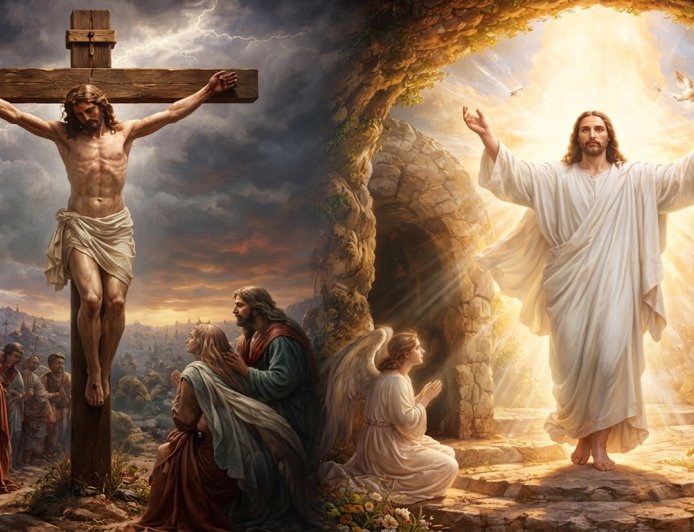
Early on wednesday morning, they go to Golgotha, which means the place of the skull, to crucify Jesus. Perhaps because of the long journey or because Jesus was tired, Simon was made to carry the cross (Matthew 27:32, Mark 15:21, Luke 23:26). Jesus was crucified on wednesday, on the day of passover. (Matthew 27:35, Mark 15:24-25, Luke 23:33, John 19:18) When it was about six o'clock in the afternoon, the sun went down and darkness came over the whole land until the ninth hour (Matthew 27:45, Mark 15:33, Luke 23:44). Jesus, who was crucified at the third hour, died at the ninth hour (Matthew 27:46-50, Mark 15:34-37, Luke 23:45-46, John 19:30). In our time, He was crucified at nine o' clock in the morning. At twelve noon, the sun darkens. It continued until three o'clock and Jesus died at three o' clock in the afternoon. Then, after the ninth hour according to their time, after the death of Jesus the soldiers, at the request of the Jews, come and pierce Jesus' side with a spear and break the legs of the other two (John 19:31-37). Thus, Jesus lies on the cross from the ninth hour until the twelfth hour, or after the day till dusk (Matthew 27:57). On the day of passover, the passover lamb is slaughtered at dusk (Exodus 12:6). Our passover lamb, Jesus, was also killed on the day of passover wednesday and remained on the cross until dusk (1 Corinthians 5:7). When the evening was come Joseph of Arimathea and Nicodemus buried Jesus in a tomb (Matthew 27:57-60, Mark 15:42-46, Luke 23:50-53, John 19:38-42). The day Jesus died was also the preparation day for the sabbath (Matthew 27:62, Mark 15:42, Luke 23:54, John 19:33). The passover day ended in the evening on the fourteenth day of the first month. The passover was observed at dusk that day (Leviticus 23:5-6). The sabbath, which began on wednesday evening and ends on thursday evening, is a holy assembly day (Exodus 12:16-18). The day Jesus died was not only the day of passover but also the preparation day for the great sabbath, which follow the first day of unleavened bread (John 19:31). When Jesus was buried, the preparations were completed and the sabbath began (Luke 23:54). On the sabbath day after the preparation day, the soldiers sealed the tomb and guarded it (Matthew 27:62-66). The great sabbath, which began on wednesday evening, ends on thursday evening. After the sabbath, the women go out on friday morning and buy spices (Mark 16:1). The spices and fragrant oil were prepared on that day. From that evening until saturday evening, they rest because it is the weekend sabbath (Luke 23:56).
When the women came to the tomb early on the first day of the week after the sabbath the tomb was opened (Matthew 28:1, Mark 16:2-4, Luke 24:1-2, John 20:1). Only matthew’s gospel says that after the women arrived, an earthquake occured and an angel comes and rolls away the stone (Matthew 28:2-7). The angel said that Jesus is not there, but has risen. Since the resurrection of Jesus didnot seen at that time. All the gospels do not specify when Jesus rose, except that they say that he did rise (Matthew 28:5-7, Mark 16:5-6, Luke 24:4-6). If we listen to Jesus' words, He said that just as Jonah was in the belly of the whale for three nights and three days, even so Jesus will be in the heart of the earth for three nights and three days (Matthew 12:40). The chief priests and Pharisees reminded Pilate that Jesus had said that he would raise up after three days of His death (Mark 8:31) and asked him to seal the tomb and make it secure (Matthew 27:63). Therefore, Jesus rose from the dead after these three days. Jesus was crucified on wednesday and was buried at dusk on that day. Jesus remained in the tomb for three days, wednesday night, thursday day, thursday night, friday day, friday night, and saturday day. As Jesus said, it is three days which is three nights and three days. Then Jesus rose from the dead on saturday night. When Mary Magdalene came to the tomb early, while it was yet dark, she found the tomb opened (John 20:1). Therefore, Jesus may have risen as the night began to fall after the day of saturday. But it was on the first day of the week that Jesus appeared to everyone and revealed himself (Matthew 28:9-10, Mark 16:9,12, Luke 24:13-15, John 20:1,16-17,19). Thus, the last days of Jesus were an eventful one that lasted a whole week from monday to sunday. With the saving works of Jesus, which took place in the fullness of seven days, Jesus is able to save completely those who draw near to God through Him, and He still intercedes for us before God (Hebrews 7:25). May those who believe in their hearts by understanding these truths that God raised Jesus from the dead be saved (Romans 10:9-10). May the God of all grace save and bless us according to the abundance of his grace.


